

A period that arrives early, late, or not at all makes it difficult to know whether ovulation occurred and when pregnancy is possible. By tracking dates, bleeding, cervical mucus, temperature, and the limits of each sign, you can interpret your pattern more accurately and recognise when medical review is needed.
Key takeaways
- Count cycle day 1 from full menstrual flow, not light spotting.
- Irregular cycles can make calendar-only ovulation predictions unreliable.
- Combine cervical mucus, LH tests, and temperature for stronger clues.
- Seek medical review for skipped periods or persistently irregular ovulation.
What Your Cycle Dates Reveal About Ovulation
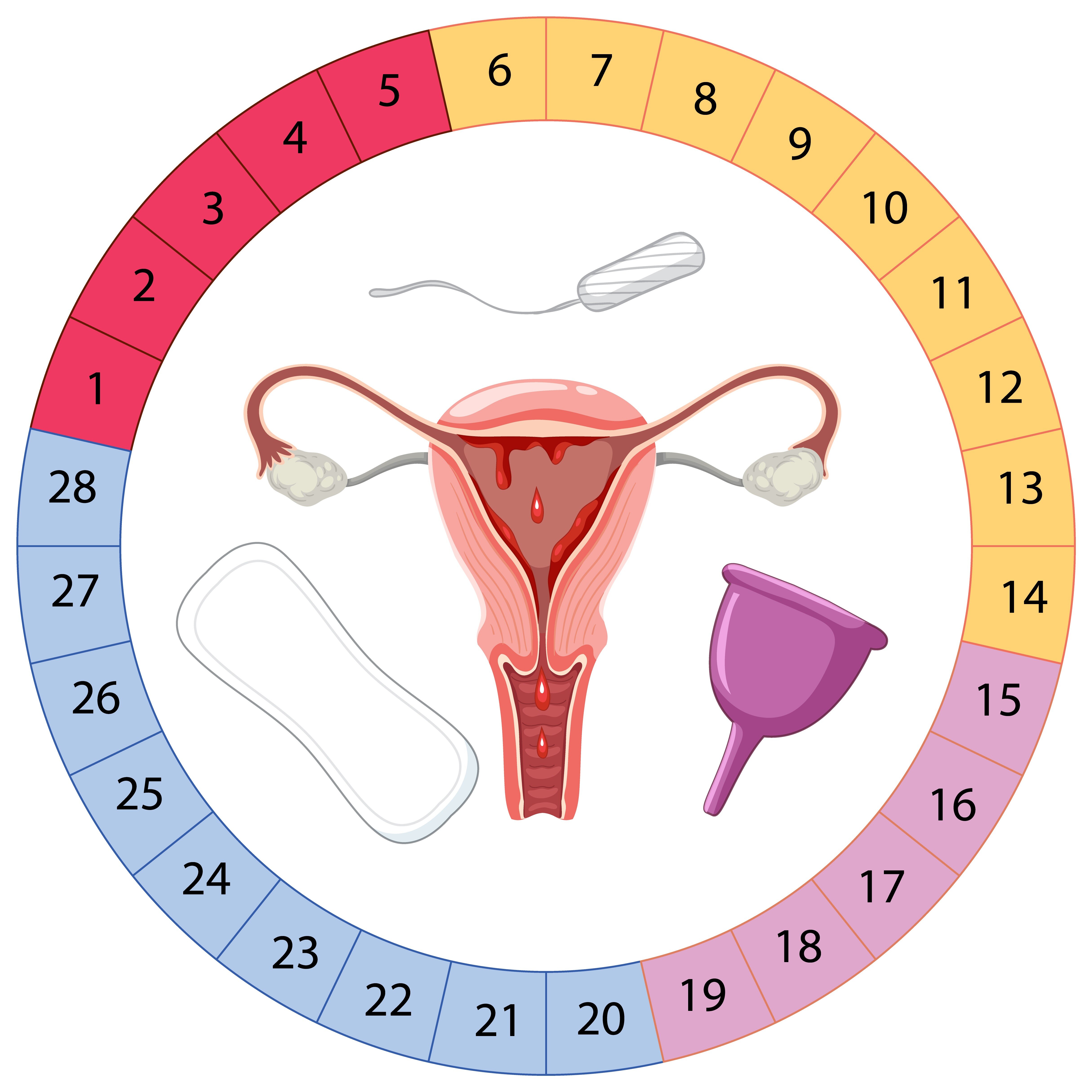
Cycle day 1 is the first day of full menstrual flow, not light spotting. Count the cycle through the day before the next period begins. A cycle under 21 days is short; over 35 days is long. A variable cycle changes substantially in length, while a skipped cycle has a long gap without bleeding.
- Record the date full flow starts in a calendar or notes app.
- Record the next date full flow starts.
- Count from the first date through the day before the next start date.
- Repeat for several cycles and compare the lengths.
Irregular periods do not prove that ovulation never occurs. Ovulation may be delayed, happen in only some cycles, or be absent. Pregnancy can still occur when bleeding does not follow a predictable monthly pattern.
The “day 14” rule fits only a roughly 28-day cycle. A practical fertility awareness estimate places ovulation about 12–14 days before the next period, so variation usually occurs before ovulation. For example, if your next period begins on day 40, ovulation may have occurred around days 26–28, not day 14.
Calendar calculations and fertility apps lose accuracy when cycle lengths vary because they project future ovulation from past averages. A changing or skipped cycle gives the calculation no dependable anchor, so treat app predictions as estimates rather than proof of ovulation.
How Irregular Bleeding Can Reflect Different Ovulation Patterns
A long cycle does not automatically mean that ovulation failed. If full flow began on January 1 and the next period began on February 15, the cycle lasted 45 days; ovulation may have occurred around days 31–33, not day 14. The later bleed followed roughly 12–14 days after ovulation.
| Pattern | What it may mean | What the bleeding proves |
|---|---|---|
| Delayed ovulation | The egg was released later, extending the cycle before ovulation | Nothing by itself |
| Anovulation | No egg was released; a skipped period can follow this pattern | No evidence of ovulation |
| Non-menstrual bleeding | Spotting or bleeding from another cause, not the end of an ovulatory cycle | Nothing about ovulation |
Record spotting separately from full menstrual flow. Light bleeding before heavier flow can arise from hormonal changes, infection, contraception, breastfeeding, or other causes, so counting it as cycle day 1 can misdate the entire cycle.
Irregular periods do not diagnose PCOS, although PCOS is a frequent cause of unpredictable or absent ovulation. A PCOS diagnosis combines ovulatory dysfunction, clinical or biochemical androgen excess, and polycystic ovarian morphology after other causes have been excluded.
Bleeding alone cannot prove that an egg was released; confirmation requires a pattern such as a sustained temperature rise or appropriately timed clinical testing.
How Cervical Mucus, LH Tests, and Temperature Work Together
Use cervical mucus, urinary LH tests, and basal body temperature together, because each answers a different question when irregular periods shift ovulation.
Cervical mucus usually moves from dry or sticky to wetter, clearer, and more slippery as fertility rises. Bleeding, semen, lubricants, vaginal infection, breastfeeding, and hormonal medication can obscure that pattern. With PCOS, you may see several episodes of fertile-type mucus rather than one clear fertile phase.
| Sign | What it shows | Main limitation |
|---|---|---|
| Cervical mucus | Rising fertility before ovulation | Several mucus episodes can occur with PCOS |
| Urinary LH test | An LH surge is occurring | An LH-positive result does not prove ovulation |
| Basal temperature | A sustained post-ovulation pattern | It confirms ovulation retrospectively, not reliably beforehand |
PCOS can also cause repeated urinary LH rises without egg release. Treat each positive result as evidence of an LH surge, not proof that ovulation occurred.
Take your basal body temperature immediately after waking, before getting out of bed, at a consistent time and with the same method. Record illness, fever, alcohol, disturbed sleep, travel, and shift work because each can distort a reading.
A sustained rise after ovulation reflects progesterone and confirms a pattern retrospectively; temperature alone is not a dependable prediction tool.
For fertility awareness, combine several signs across the cycle instead of relying on one reading. Mucus can identify changing fertility earlier, while temperature can show whether the pattern was followed by ovulation.
How to Use Fertility Awareness When the Fertile Window Is Unpredictable
Fertility awareness for irregular periods cannot safely rely on one predicted calendar date. Pregnancy is possible from about five days before ovulation through the day of ovulation: sperm can survive for several days in fertile cervical mucus, while the egg remains fertilisable briefly after release.
Use this approach:
1. Treat each day as potentially fertile when ovulation timing is unclear. Counting forward from the previous period cannot safely shorten the interval, because ovulation may occur much later than expected. Calendar calculations and fertility apps lose accuracy as cycle lengths vary.
2. Do not apply the Standard Days Method unless cycles consistently last 26–32 days. It identifies days 8–19 as potentially fertile; do not extend those rules to shorter, longer, or highly variable cycles.
3. If you are trying to conceive, have intercourse on successive days when mucus becomes wetter, clearer, or slippery, and continue around the likely ovulation window. Waiting for a fixed cycle day can miss ovulation.
4. If you are avoiding pregnancy, follow the instructions of a validated fertility-awareness method. Use abstinence or a barrier method, such as condoms, throughout that method’s identified fertile days; effectiveness varies by method and user.
The fertile window is biological, not a calendar label. A clinician can help if mucus patterns remain confusing or ovulation is difficult to identify.
When Irregular Ovulation Needs Medical Review
Seek medical review when irregular periods repeatedly fall outside your previous pattern, especially in these situations:
| Pattern | When to seek assessment | Why it matters |
|---|---|---|
| Cycles | Less often than every 35 days or more often than every 21 days | Ovulation may be delayed, inconsistent, or absent |
| Bleeding | Lasts over 7 days | Heavy or prolonged bleeding needs evaluation |
| Pattern change | Becomes markedly different from your usual cycles | A new hormonal or medical cause may be present |
| Very infrequent bleeding | Long gaps or skipped bleeds | Prolonged anovulation can affect the uterine lining |
Prolonged anovulation exposes the endometrium to unopposed oestrogen. A clinician may recommend treatment to induce withdrawal bleeding or protect the uterine lining, even when pregnancy is not currently desired.
If you are trying to conceive, seek assessment sooner when periods are irregular or absent instead of waiting 12 months. The usual thresholds—12 months under age 35 or 6 months at age 35 or older—apply when cycles are regular.
Serum progesterone should not automatically be tested on day 21. It is most informative about one week before the expected next period, so a long cycle may require later or repeated testing. A result above 3 ng/mL commonly supports recent ovulation, but does not measure the entire luteal phase.
Dr Pavan Bendale - IVF Specialist can match your cycle records and symptoms with appropriately timed testing in Wakad, rather than relying on a fixed calendar day.
Frequently asked questions
What does cycle length reveal about ovulation?
Cycle dates show whether your periods are short, long, or variable, but they cannot reliably identify ovulation when cycle length changes.
How can irregular bleeding affect fertility awareness?
Spotting, skipped cycles, and variable bleeding can make cycle-day calculations misleading and may reflect different ovulation patterns.
Which fertility-awareness signs help identify ovulation?
Cervical mucus, luteinising hormone tests, and basal body temperature provide complementary clues about the fertile window and ovulation.
When should irregular ovulation receive medical review?
Arrange a medical review for persistently irregular periods, skipped cycles, very short or long cycles, or difficulty identifying ovulation.