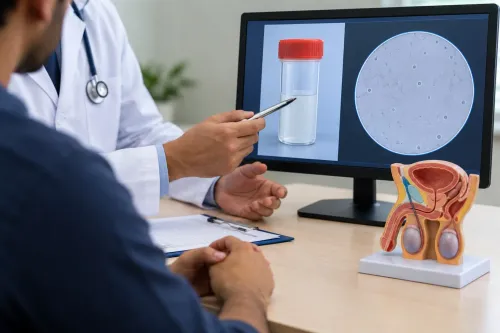



A first quote for male infertility treatment can cover only the appointment and leave semen testing, hormone work, surgery, sperm retrieval, embryology, storage and later IVF or ICSI charges unstated. By the end, you will have a practical question list for comparing the full treatment pathway, understanding what a low sperm count or nil sperm count result changes, and judging whether the proposed spending matches a medically defined goal.
Key takeaways
- Request itemized costs from diagnosis through treatment and follow-up.
- Ask what happens financially if testing, surgery, retrieval or a cycle fails.
- Compare the full likely budget, not only the lowest IVF package.
- Require outcome data, alternatives and exclusions in writing.
What should a complete male infertility cost estimate include?
A complete male infertility treatment cost estimate should map spending from diagnosis through fertility treatments, not quote only an IVF package. Ask for an itemized document showing what happens if testing, surgery, retrieval or a cycle fails.
1. Diagnosis: consultation; semen analysis and repeat semen analysis; written abstinence and collection instructions; hormone and infection blood tests; scrotal ultrasound; sperm function testing; karyotype; and Y-chromosome microdeletion testing.
2. Treatment: medicines; surgery; anaesthesia; operating-room charges; sperm retrieval; embryology; IUI; IVF; ICSI; and embryo transfer. Ask whether blood tests, follow-up visits, medicines and failed-cycle care are included.
3. Sperm storage: confirm the freezing method, number of samples and frozen straws, storage period, renewal fee, disposal or transfer conditions, thawing charge and use in a later cycle. Sperm freezing is often billed separately from retrieval.
4. Require the quote to state the number of visits and samples covered, plus separate charges for complications, additional embryo transfers, donor sperm or other donor material. Ask what you pay if no sperm is found, eggs are not collected, fertilisation fails or no embryo is suitable for transfer.
5. Financial terms: ask for payment schedules, cancellation charges, refund rules, tax documents, employer benefits, insurance exclusions and financing costs. Confirm whether the estimate includes GST and whether each failed cycle, repeat retrieval or frozen cycle creates a new fee.
How does the diagnosis change the treatment budget?
The same male infertility treatment cost cannot apply to every diagnosis because each one changes the tests, treatment, laboratory work and chance of needing assisted conception.
Low sperm count, poor motility or abnormal morphology may lead to repeat testing, medicines, IUI, IVF or ICSI; infection, hormonal disease, erectile or ejaculation disorders may need targeted treatment first.
One abnormal semen analysis does not decide the procedure or budget. Concentration, motility, morphology and semen volume vary between samples, so ask:
- When should the semen analysis be repeated, and how many days of abstinence are required?
- Must the sample be produced at the laboratory, and how quickly must it be delivered?
- Will hormones, infection tests, examination, scrotal ultrasound or sperm-function testing change the plan?
A nil sperm count is azoospermia, not an automatic recommendation for donor sperm. Obstructive azoospermia means sperm production may continue behind a blockage; reconstruction or epididymal aspiration could be relevant.
Non-obstructive azoospermia means impaired production, so hormones, genetic testing, imaging and examination may determine whether testicular sperm aspiration, testicular sperm extraction or microsurgical testicular sperm extraction is worthwhile.
Testosterone replacement can suppress pituitary signals and sperm production; it is not a fertility treatment. Disclose all testosterone use and ask about specialist hormonal treatment instead.
For a clinically palpable varicocele, ask what evidence supports repair in your case, what recovery time applies, and how often assisted conception is still needed afterward. Do not pay to treat an imaging-only, non-palpable varicocele without a clear rationale. The diagnosis drives the budget, not the label “male infertility.”
Should you treat the male factor first or proceed to IUI, IVF or ICSI?
Correct the cause first when it offers a realistic chance of restoring sperm production or delivery. Specialist-directed gonadotrophin treatment suits selected men with hypogonadotropic hypogonadism, but involves months of injections and monitoring, and assisted fertility treatments may still be needed. Varicocele repair adds surgical recovery time.
Infection or ejaculation-disorder treatment requires time before repeat semen testing shows whether it worked.
| Option | When it applies | Cost and suitability question |
|---|---|---|
| IUI | Usable sperm remain and tubes are open | It may be unsuitable with very low usable sperm numbers, blocked tubes or significant female-partner factors. |
| IVF | Eggs and sperm can be combined in the laboratory | IVF may not solve severe sperm deficiency; ask whether retrieval or ICSI is also priced. |
| ICSI | One sperm is injected into one egg | Consider very low numbers, surgically retrieved sperm or previous poor fertilisation. It is not automatic for every low sperm count; ask why it costs more than standard IVF. |
For severe azoospermia, or a nil sperm count, ask whether epididymal aspiration, testicular sperm aspiration, testicular sperm extraction or microsurgical testicular sperm extraction is planned and included in the male infertility treatment cost. Female-partner treatment may need to happen simultaneously or first.
Judge the result on the clinical timeline, not after one procedure: allow surgery recovery, complete repeat semen testing after treatment, and budget for another cycle if sperm parameters, fertilisation or embryo development remain inadequate. Ask which finding would change the plan from correction to IUI, IVF, ICSI or donor sperm.
How do you compare a low quote with the likely total cost in Pune?
A low quote is useful only when it covers the same pathway as a higher quote. Compare the likely total male infertility treatment cost, not an advertised IVF or ICSI package.
| Check | Lower quote may exclude | Ask for |
|---|---|---|
| Clinical care | Hospital level, specialist fees, laboratory facilities, medication brands, anaesthesia and operating-room use | An itemised amount for each |
| Laboratory pathway | Embryology, surgical retrieval, genetic testing, donor sperm and cryopreservation | Charges for each possible result |
| Later treatment | Storage renewal, thawing, frozen embryo transfer and follow-up | The included storage period and renewal fee |
Ask what you pay if no sperm is found, eggs are not collected, fertilisation fails, no embryo suits transfer, or a fresh cycle fails. Price repeat cycles, repeat retrieval, an additional embryo transfer and long-term frozen-sperm storage separately.
- Ask whether collection appointments, blood tests, imaging, medication monitoring and surgery recovery visits are included.
- Add missed work and travel from Wakad across Pune when providers are in different locations.
- Confirm whether one centre coordinates surgery, laboratory work and embryology, or refers each service elsewhere.
At a consultation with Dr Pavan Bendale - IVF Specialist, request a written pathway estimate dividing medical necessity, optional services and charges triggered by each result. Compare the cost and time of fertility treatments across the complete pathway, not just the first procedure.
What outcome, success data and alternatives should the quote promise?
An estimate is meaningful only when it names the endpoint: improved semen parameters, sperm retrieval, fertilisation, embryo creation, pregnancy or live birth. These are different outcomes, with different costs, and a clinic cannot guarantee a live birth.
1. Ask whether results are specific to the female partner’s age and the male infertility diagnosis. Require figures per IUI cycle, IVF egg retrieval, embryo transfer and cumulative treatment pathway, with live-birth or cumulative-live-birth rates rather than pregnancy rates alone.
2. Ask how often patients need sperm retrieval, donor sperm, frozen embryo transfer or another cycle. Get written charges for repeat testing, failed retrieval, failed fertilisation, cycle cancellation, unsuitable embryos and embryo transfer.
3. Ask what happens after a low sperm count or nil sperm count result before accepting ICSI. Indefinite semen tests, repeated empirical medicines without a diagnosis and expensive ICSI before evaluating azoospermia are poor-value warning signs.
Ask about staged evaluation, reversible causes, surgical referral, sperm banking, donor sperm and other family-building routes, including medical and ethical implications.
4. Bring every semen report, medication and supplement list, testosterone-use history, surgery history, childhood illness history and fertility history. Ask whether insurance, employer support or financing changes only the payment sequence, not the medically indicated treatment.
A credible quote should show the cost and decision point for each pathway, including repeat retrieval or another cycle. Otherwise, the headline male infertility treatment cost is not a realistic cost of pursuing a baby.
Frequently asked questions
What should a complete male infertility cost estimate include?
Ask for itemized charges covering consultation, semen analysis, hormone tests, genetic testing, imaging, medicines, surgery, sperm retrieval, laboratory work, IUI, IVF or ICSI, storage, follow-up and extra-cycle costs. Confirm what happens if a test, procedure or treatment cycle fails.
How does the diagnosis change the male infertility treatment budget?
Low sperm count may require different testing and treatment from nil sperm count. Obstruction, varicocele, hormonal disorders, genetic findings and azoospermia can add surgery, sperm retrieval, medication or donor-sperm costs. Request a diagnosis-specific estimate rather than a standard package.
Should you treat the male factor first or proceed to IUI, IVF or ICSI?
The choice depends on sperm results, the cause of male infertility, female fertility factors, age, duration of infertility and previous treatment. Ask which problems are treatable first, how long treatment would take and how each option changes the expected total cost.
How do you compare a low quote with the likely total cost in Pune?
Compare identical inclusions: consultations, tests, medicines, anaesthesia, laboratory procedures, sperm retrieval, embryo work, storage, taxes, cancellation rules and follow-up. Ask for the expected total across one cycle and the cost of common add-ons or another attempt.
What outcome, success data and alternatives should the quote promise?
A quote should not promise a pregnancy. Ask for clinic-specific outcome data, the denominator used, the relevant age and diagnosis groups, cancellation and failure policies, and alternatives such as treatment of the male factor, IUI, IVF, ICSI or donor sperm.